Presenting at the American Sociological Association's Communication, Information Technologies, and Media Sociology Section Annual Symposium

The Everyday Misinformation Project team will be presenting its latest findings at the American Sociological Association (ASA) Media Sociology Symposium on August 4.

Our talk is entitled ‘“I Would Always be Careful About What I Receive”: Online Misinformation, Epistemic Norms, and Social Distinction,’ and is by Natalie-Anne Hall, Andrew Chadwick and Cristian Vaccari.

In this latest study from the project, based on a thematic analysis of longitudinal, in-depth interview data (N=182) we reveal some key epistemic norms governing the everyday consumption and sharing of information and the social distinctions these norms establish. In the qualitative phase of our fieldwork, many participants who said they did not frequently encounter misinformation through personal messaging were well aware of its existence, and willingly expressed views about those they believed were taken in by it. Deception was presented as a problem experienced by others who are more “naïve,” “biased,” or less “media literate” than themselves. These narratives reflect a keen awareness of the normative epistemic value placed on objectivity and media literacy in today’s societies. However, they simultaneously reveal that those making such social distinctions are less likely to value anti-misinformation interventions because they are deemed irrelevant to their individual everyday practices. This conflicts with the reality that addressing misinformation must inevitably be a collective and inclusive social endeavour.

The symposium will be held virtually, and our session will be at 10am PDT, which is 6pm BST. Registration details and the programme can be found here.

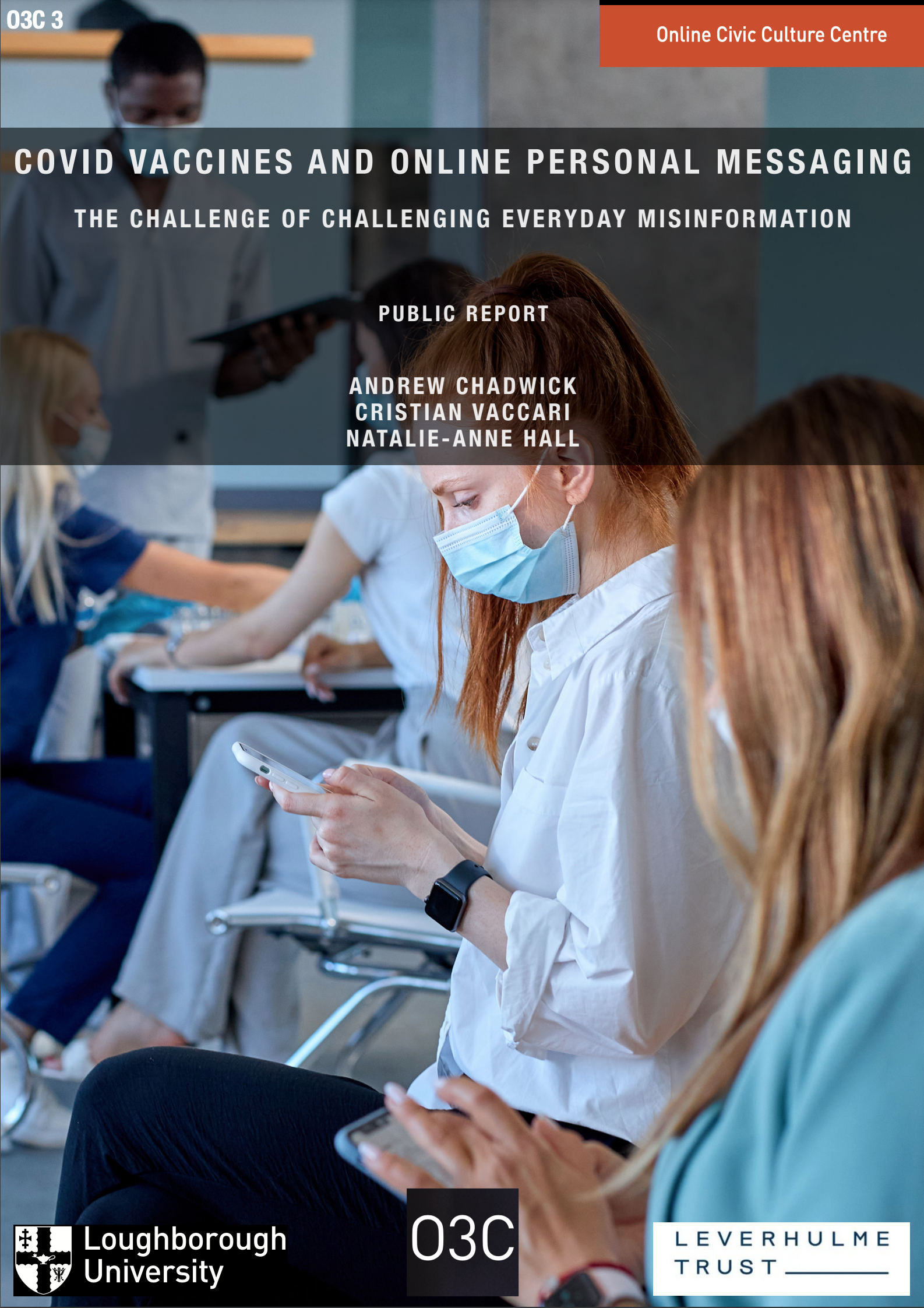
On the Social Media and Politics Podcast discussing the new public report on Covid Vaccine Misinformation and Personal Messaging

On the Social Media and Politics Podcast discussing the new public report on Covid Vaccine Misinformation and Personal Messaging

Last week I appeared on the Social Media and Politics Podcast to talk about the new public report Covid Vaccine Misinformation and Personal Messaging: The Challenge of Challenging Everyday Misinformation. We had a wide ranging discussion covering the hybrid character of this engagement, the role of qualitative research in project designs, and the importance of person-centred solutions to countering online misinformation.

Read More

New Public Report: Covid Vaccines and Online Personal Messaging: The Challenge of Challenging Everyday Misinformation

New Public Report: Covid Vaccines and Online Personal Messaging: The Challenge of Challenging Everyday Misinformation

Today we publish the first public report from the Everyday Misinformation Project. Covid Vaccines and Online Personal Messaging: The Challenge of Challenging Everyday Misinformation uncovers the social norms that shape whether and how people do or do not challenge misinformation about Covid vaccines on personal messaging platforms such as WhatsApp and Facebook Messenger.

Read More

Guest Post: Rasmus Kleis Nielsen and Sarah Anne Ganter on their new book The Power of Platforms

Guest Post: Rasmus Kleis Nielsen and Sarah Anne Ganter on their new book The Power of Platforms

In the latest Guest Post by authors from the Oxford Studies in Digital Politics series, Rasmus Kleis Nielsen (Reuters Institute, Oxford University) and Sarah Anne Ganter (School of Communication, Simon Fraser University) write about their new book The Power of Platforms: Shaping Media and Society. Out now.

Read More

New Journal Article—“Deception as a Bridging Concept in the Study of Disinformation, Misinformation, and Misperceptions”—Out Now in Communication Theory

New Journal Article—“Deception as a Bridging Concept in the Study of Disinformation, Misinformation, and Misperceptions”—Out Now in Communication Theory

My Loughborough colleague James Stanyer and I have a new article out in Communication Theory: Deception as a Bridging Concept in the Study of Disinformation, Misinformation, and Misperceptions: Toward a Holistic Framework.

The origins of this piece go back to conversations we started having a couple of years ago about the curious lack of attention to deception in the research on misinformation, disinformation, and misperceptions.

Read More

New Study from the OCEANS Project: Effects of Different Types of Written Vaccination Information on Covid-19 Vaccine Hesitancy in the UK (OCEANS-III): A Randomised Controlled Trial

New Study from the OCEANS Project: Effects of Different Types of Written Vaccination Information on Covid-19 Vaccine Hesitancy in the UK (OCEANS-III): A Randomised Controlled Trial

The latest study from the OCEANS vaccine hesitancy project is out today in The Lancet Public Health. With OCEANS III, we developed ten different information messages and tested their impact on vaccine hesitancy. To do this, we held a randomized controlled trial involving 18,885 UK adults.

The findings surprised us.

Read More

Three New Books in the Oxford Studies in Digital Politics Book Series

I’m excited to announce three new titles in the Oxford Studies in Digital Politics series:

  • Sarah Sobieraj’s Credible Threat: Attacks Against Women Online and the Future of Democracy.

  • Jack Parkin’s Money Code Space: Hidden Power in Bitcoin, Blockchain, and Decentralisation.

  • Rachel K. Gibson’s When the Nerds Go Marching In: How Digital Technology Moved from the Margins to the Mainstream of Political Campaigns.

You can read more about these books at the OUP website by clicking on the covers below. Or you can visit the series homepage.

New Piece: Corrupted Infrastructures of Meaning: Post-truth Identities Online

New Piece: Corrupted Infrastructures of Meaning: Post-truth Identities Online

Catherine R. Baker and I have just completed a new article: “Corrupted Infrastructures of Meaning: Post-truth Identities Online.”

The piece is a contribution to Howard Tumber and Silvio Waisbord’s exciting new edited volume, The Routledge Companion to Media Misinformation and Populism, which is forthcoming with Routledge. We develop a conceptual framework for examining how post-truth identities are developed and maintained online. Part of our task involves defining what post-truth identities are, and how they are the result of a confluence of cognitive biases at the individual level and a range of media system factors. We illustrate these conceptual themes with discussion of three cases: ‘anti-vaxxers,’ ‘flat earthers,’ and ‘incels.’

Read More